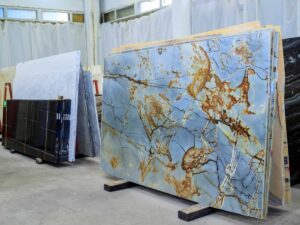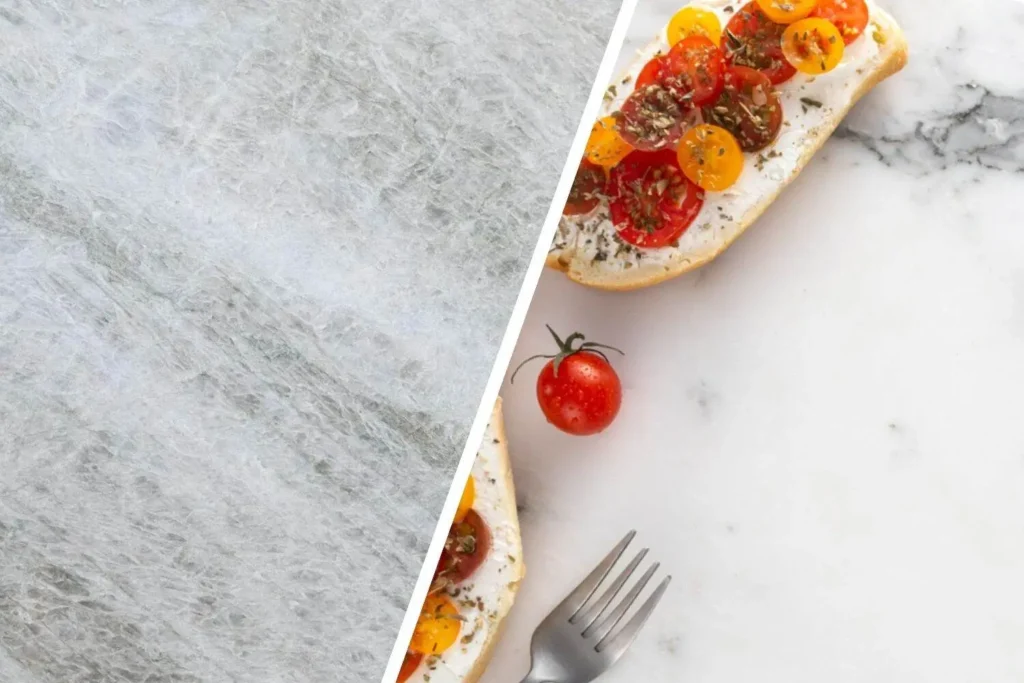
If you are in the process of choosing a natural stone for your countertop, chances are you are in between quartzite vs marble. Quartzite and marble are not only some of the most popular materials, but their striking visual similarity might make it that much more difficult. Both offer gorgeous veining patterns, beautiful natural colors, and a luxurious appearance.
However, the choice between these two isn’t only reliant on their appearance. While they look similar, quartzite and marble have a lot of differences that might make homeowners favor one over the other. The decision is about maintenance, lifestyle, resale value, and so much more.
While both are great options, and you can’t go wrong with either one of them, one is likely to be more suitable for your daily routine. Keep reading to find out more about the durability, upkeep, and cost of quartzite vs marble stones for countertops so that you can confidently choose the best natural stone for kitchen use in your home.
Understanding Quartzite and Marble
Before we dive into comparisons between the two, it is important to establish a basic understanding of these stones to better appreciate the reasons for their differences.
Marble forms from limestone under heat and pressure. As the limestone heats and compresses, it develops its signature structure of gorgeous veins and slightly softer texture. Similarly, quartzite also takes its final form under immense heat and pressure. However, it originates as sandstone, giving quartzite a stronger starting point.
Marble is considered to be a comparatively softer stone because its parent stone, limestone, is itself soft. Although it significantly hardens when it does go through the metamorphic process, marble is still not as hard as some other natural stones like granite or quartzite.
Their different origins are the source of most countertop material comparison discourse. Quartzite is known for its resilience, whereas marble is applauded for its striking and elegant appearance. They behave differently and require different levels of care because of their formation.
Durability and Everyday Performance
Durability is often one of the most important factors for homeowners in making the final decision between quartzite vs marble. Kitchens are high-traffic spaces with lots of moisture, sharp objects, and spills; therefore, a strong and durable countertop material is a must.
Quartzite is a tough material. Depending on the type of quartzite, it can be even harder than granite. This means you can use your quartzite kitchen countertops without having to constantly worry about damaging, staining, or chipping them. For busy households or frequent cooks, quartzite countertops offer peace of mind and a reliable work surface.
As mentioned before, marble is considered to be relatively softer for a stone, especially compared to such hard materials as granite or quartzite. However, this doesn’t mean that it is inherently unsuitable for kitchen countertops. Marble can show wear and tear more easily, but that isn’t a negative. Most homeowners love the organic look of marble and prefer a stone that shows its history.
Maintenance and Daily Care
Maintenance is an area where the differences between the two become even clearer. Although factors such as the functionality and beauty of the stone can be subjective, its required maintenance can be a dealbreaker for homeowners with busy lives.
In general, marble stone countertop maintenance requires more awareness and attention than quartzite. This is due to the reaction marble has when it comes into contact with acidic liquids such as lemon juice and vinegar. Acids cause marble surfaces to etch, meaning a white, dull, and matte spot replaces the beautiful and lively patterns of the stone.
Both marble and quartzite are porous stones. This means both of them require resealing periodically after a certain amount of use. How often you should reseal depends on the type of stone, the quality of the stone, and how heavily the countertops are used. On average, you should reseal natural stone countertops every 6 months to a year.
Appearance, Design, Flexibility, and Versatility
The appearance of the stone as well as the design flexibility it provides, are major components in the decision. Marble has a unique and distinct look. The moment you look at a natural marble slab, there is no mistaking it. Its slightly transparent look, luminous quality, elegant veins, and subtle colors set it apart from all the competition.
Quartzite has a similar look to marble, especially slabs with lighter colors and flowy veining patterns. However, where quartzite differs is in the subtle details. In general, quartzite has a bolder, more dramatic look. Marble has soft and hazy transitions, whereas quartzite is more linear.
When it comes to the appearance of the stones, no one choice is right or wrong. Marble is usually preferred by homeowners who are after a glamorous, natural, and sophisticated look. Quartzite pairs amazingly well with clean, minimalist designs and modern kitchens.
Quartzite vs Marble: Pros and Cons
When weighing in the marble and quartzite stone countertops pros and cons, factors like durability, aesthetic appeal, heat-resistance, and budget-friendliness are the first ones that come to mind.
Quartzite can easily resist scratches and stand up to frequent use. Both marble and quartzite have amazing heat-resistance abilities. However, as they are natural stones, they need to be resealed. In general, the sealers aren’t as resistant to the heat as the stones themselves. Therefore, the use of trivets is still recommended.
Marble has the unique ability of keeping a cool temperature even in hot climates. This is especially helpful for bakers who need ingredients like butter or chocolate to stay firm.
While its softness makes marble easier to scratch, it also makes it easier to fabricate. Ornate edge profiles or custom cutouts are easier to achieve with marble slabs, making them an ideal choice for intricate designs.
Long-Term Value and Cost
Arguably, the cost of the stone is the ultimate deciding factor for homeowners. Even the most beautiful and durable stone might not be the right choice if it is out of budget. Both quartzite and marble fall into the premium stone category, and the quartzite vs marble cost has a very wide range.
The price for quartzite and marble slabs depends heavily on the type, rarity, origin, and thickness. Moreover, if you are interested in implementing custom designs, ornate detailing, or intricate cutouts, the fabrication costs can also add to the price.
Quartzite and marble also have more affordable options. Slabs with common colors and patterns are more budget-friendly than rare or exotic types. Moreover, the long-term value of the stone isn’t only reliant on the upfront cost. Maintenance, refinishing, resealing, and the longevity of the countertops are also factors that should be considered as part of the cost.
When it comes to quartzite vs marble countertops, the right choice between the two depends solely on your needs and wants as the homeowner. While each stone has its own unique and strong qualities, which ones you value and which ones you can do without is something only you can decide.
If you want countertops that are as easy to maintain as possible, then quartzite might be the right option for you. On the other hand, if you are after the sophisticated aura that marble brings to any room it is installed in, then the answer is clear.
Both materials are popular options for their longevity, elegance, and functionality. The key to picking the right one for you is aligning the stone with your lifestyle so that it can continue to feel right for years to come.